Environmental Scout Centre Kočevski rog

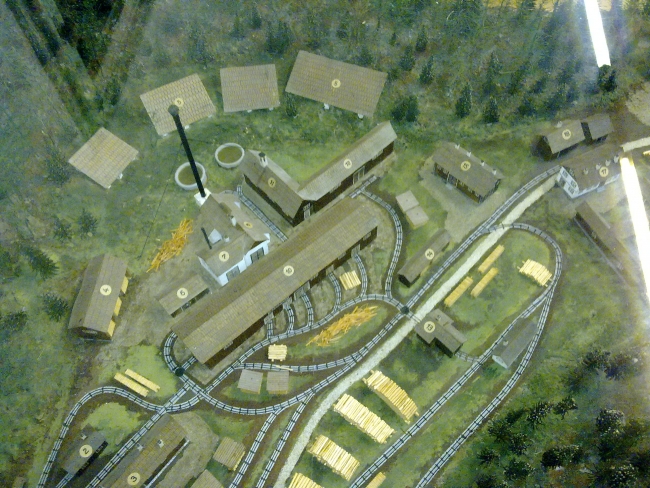
On the plateau where the Environmental Scout Centre stands today, the Rog sawmill once operated. Before the First World War it was considered the largest and most modern wood processing facility in Slovenia. The steam-powered sawmill operated from 1895 to 1932. To transport logs from the cutting sites to the sawmill, workers built a 35-kilometre narrow-gauge forest railway, whose remains are still visible today, and 30 kilometres of roads used by about 50 horse-drawn wagons that carried sawn wood down into the valley. A total of 31 buildings were constructed on the plateau below Rog.
Inside the sawmill, a horizontal steam engine with 250 HP drove seven frame saws, six half-frame saws and seventeen circular saws. The drive transmission measured 63 metres in length, and the flywheel of the steam engine had a diameter of 7 metres. The transmission pulley and the flywheel were connected by seven round camel hair ropes, each with a diameter of 8 centimetres.
They solved the lack of water in the karst landscape by building two concrete reservoirs, each 15 metres in diameter and 7 metres deep. These collected rainwater from the buildings and from special collecting roofs built on the slope below the forest. At the beginning of its operation the sawmill employed around 250 workers and by the end up to 500. Each year they processed about 50,000 cubic metres of logs. Most of the sawn wood was used for packaging production.